| Challenge Owner(s) | Housing & Development Board (HDB) |
|---|---|
| Organiser(s) |
Housing & Development Board (HDB), Enterprise Singapore, IPI Singapore
|
| Industry Type(s) |
Environmental Services, Infrastructure, Real Estate, Urban Solutions
|
| Opportunities and Support | Funding of up to 50% of development costs, mentorship, access to HDB‘s test-bed sites and support to pilot the solutions |
| Application Start Date | 30 April 2026 |
| Application End Date | 29 July 2026 |
| Website | Click here to learn more |
About Challenge
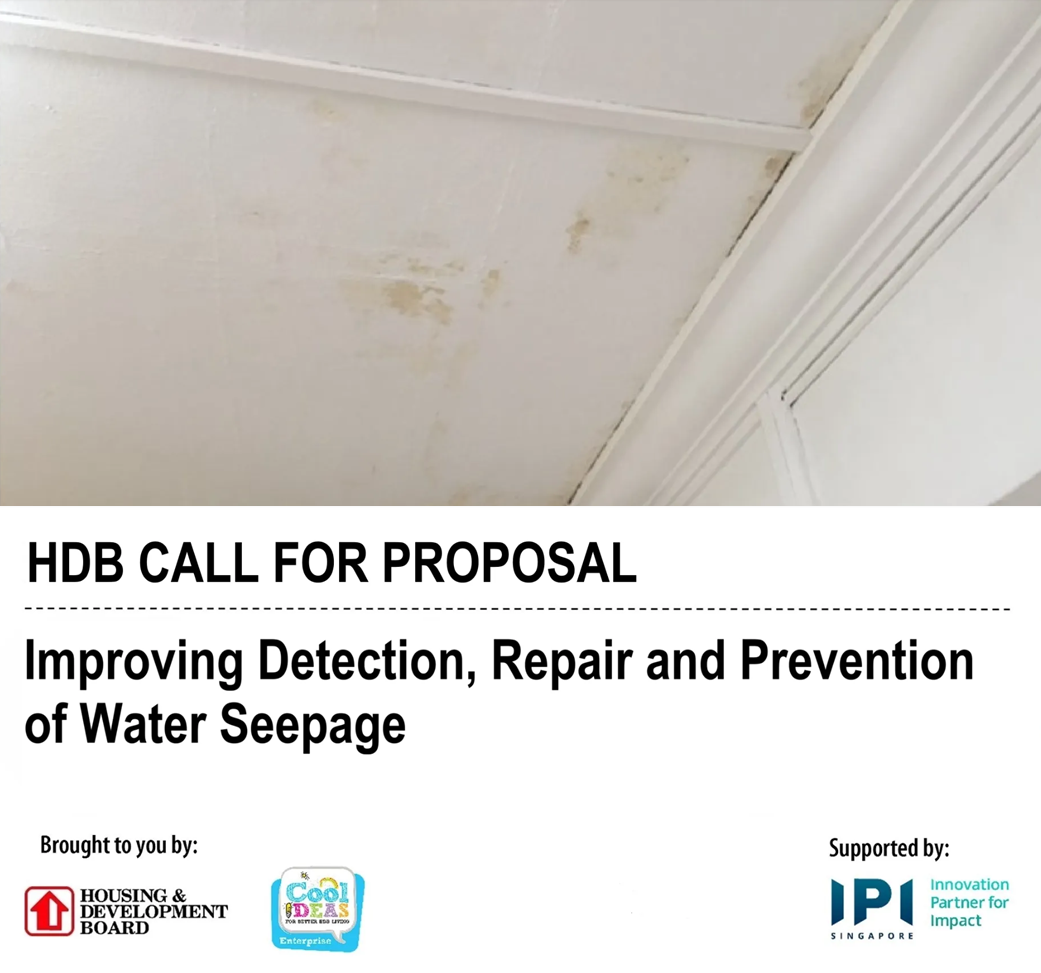
| As Singapore’s HDB building continue to age, common defects such as water seepage are becoming increasingly prevalent, requiring more timely, effective, and durable interventions. It is particularly challenging to pin-point the source of water seepage as visible damp areas often do not correspond to the actual source of water ingress. Current investigation methods may require multiple rounds of site visits with long duration of fault localisation, leading to prolonged identification of water entry/leak source and rectification. Repair works are often invasive, requiring hacking and/or removal of finishes, which results in noise, dust and extended downtime which causes inconvenience to residents. For reference on current repair approaches for seepage, solution providers may refer this link: (https://www.hdb.gov.sg/managing-my-home/renovation-and-maintenance/home-maintenance/home-care-guide/ceiling-leaks) Against this backdrop, HDB is seeking innovative and pilot-ready solutions to improve the diagnosis, repair, and long-term management of common ageing-related building defects, particularly water seepage beyond the conventional methods illustrated on HDB’s website. |
Minimally Invasive Seepage Repair with Reduced Disruption
| Challenge Owner(s) | Housing & Development Board (HDB) |
|---|
HDB is seeking repair technologies, materials, or methods that can enable more targeted and minimally invasive seepage rectification. Below are some existing repair methods:
- Re-waterproofing – Removal of bathroom tiles, application of a waterproofing membrane, followed by tile reinstatement
- Nanotechnology-based coatings – Application of waterproofing coatings directly over existing bathroom tiles
- Crack sealing – Sealing cracks with elastomeric sealants, followed by façade repainting
- Polyurethane (PU) injection – Injection treatment applied to the interior, external walls/façades to seal leakage paths
- Façade recoating – Reapplication of protective coatings on external walls/façades
- Roof repairs (top-floor units) – Replacement of defective waterproofing membranes, repair of drainage outlets, and/or application of a new roof waterproofing layer
- Plumbing repairs – Hacking of walls or floors to access and replace defective pipe sections, followed by concrete patching and repainting
Low-Dust, Low-Noise Floor Finish Removal for Seepage Repair and Home Improvement Programme (HIP) Works
HDB is seeking equipment, tools, or innovative methods that enable faster, quieter, and less labour-intensive removal of floor finishes during seepage repairs and HIP works. Conventional hacking methods generate significant dust, debris, noise, and vibration, which can be highly disruptive to residents’ daily living. In addition, the usage of the electric and pneumatic breakers can lead to sharp debris to fly about and cause injury.
| Challenge Owner(s) | Housing & Development Board (HDB) |
|---|
HDB is seeking equipment, tools, or innovative methods that enable faster, quieter, and less labour-intensive removal of floor finishes during seepage repairs and HIP works. Conventional hacking methods generate significant dust, debris, noise, and vibration, which can be highly disruptive to residents’ daily living. In addition, the usage of the electric and pneumatic breakers can lead to sharp debris to fly about and cause injury.
Effective and Speedy Detection of Water Seepage
| Challenge Owner(s) | Housing & Development Board (HDB) |
|---|
HDB is seeking solutions that can improve the speed and accuracy of diagnosing water seepage in flats and common areas. Below are some of the common detection methods and accompanying limitations:
- Visual inspection – Simple on-site inspection for water stains, paint blistering, mold growth and efflorescence. While it is fast and low cost, it posts difficulty in identifying hidden source of water seepage
- Moisture detection – Utilising moisture meter to measure water content and identify damp zones inside walls and ceilings. This potentially can give false readings and has limitations in detecting seepage in certain areas/conditions and seepage of varying depth
- Microwave concrete scanning – Utilising microwave technology to detect water pathways inside concrete slabs. This method is highly dependent on the data scanning interpretation of qualified personnel
- Hydrostatic Pressure test – Utilising pressure to check for leaks in concealed pipes
- Dye/ponding test – Commonly used to detect leaks in bathrooms, this method involves flooding the floor with dyed water. Seepage is identified by observing for the presence of coloured dye appearing on the ceiling of the unit below. The process can take several hours and is disruptive to residents
Innovative Solutions for Water Seepage
HDB is also open to other technologies, materials, methods, or systems that can significantly improve the management of water seepage defects beyond the challenge statements in this call.
| Challenge Owner(s) | Housing & Development Board (HDB) |
|---|
HDB is also open to other technologies, materials, methods, or systems that can significantly improve the management of water seepage defects beyond the challenge statements in this call.
Sign up for the latest innovation updates
Customise your preferences to receive updates in industries you're interested in.