| Challenge Owner(s) | Housing & Development Board (HDB) |
|---|---|
| Organiser(s) |
Housing & Development Board (HDB), Enterprise Singapore, IPI Singapore
|
| Industry Type(s) |
Environmental Services, Real Estate, Urban Solutions
|
| Opportunities and Support | Funding of up to 50% of development costs, mentorship, access to HDB‘s test-bed sites and support to pilot the solutions |
| Application Start Date | 30 April 2026 |
| Application End Date | 29 July 2026 |
| Website | Click here to learn more |
About Challenge
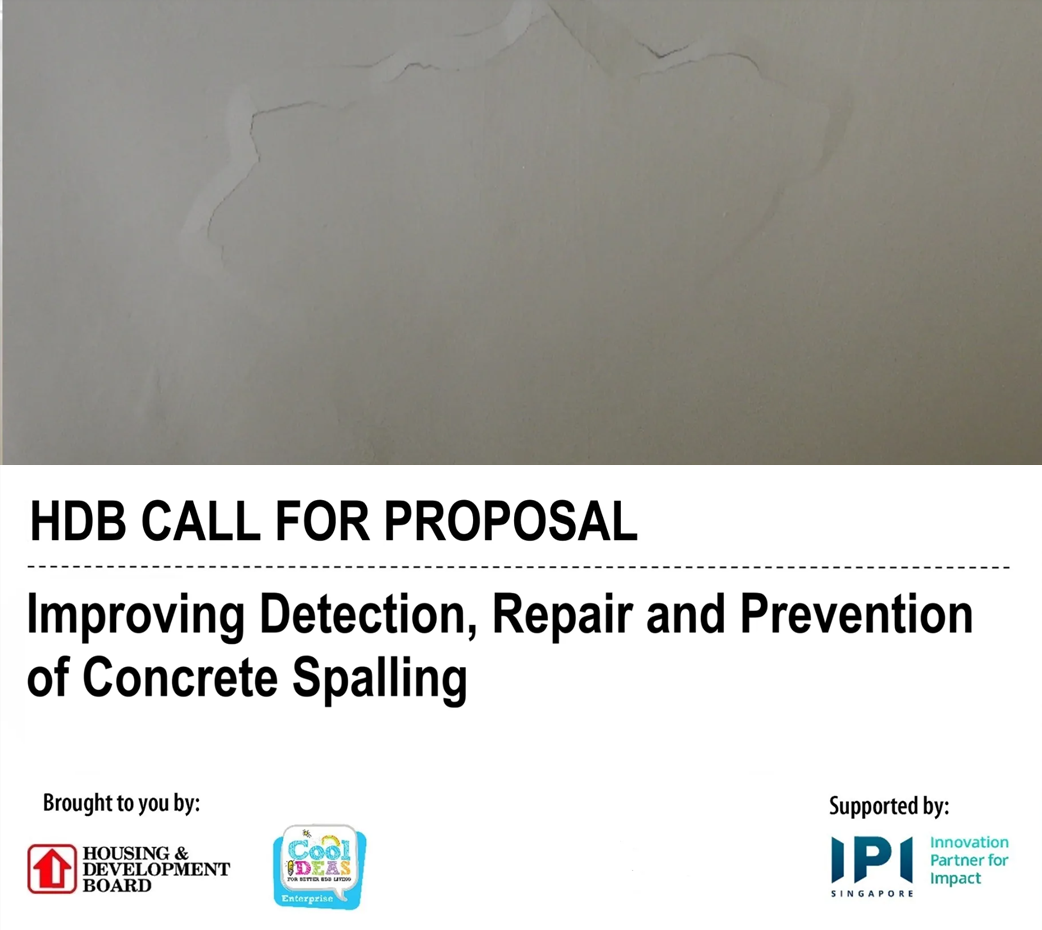
| As Singapore’s HDB building continue to age, common defects such as spalling concrete are becoming increasingly prevalent, requiring more timely, effective, and durable interventions. The detection and remediation of spalling concrete present ongoing limitations. Current inspection methods may be dependent on operator experience, may be limited in coverage, or can be ineffective in identifying concealed or early-stage deterioration before visible damage occurs. Conventional repair methods, such as patching, may not fully address the root causes of degradation, leading to recurring issues and repeated maintenance over time. For reference on current repair approaches for spalling, solution providers may refer this link: (https://www.hdb.gov.sg/managing-my-home/renovation-and-maintenance/home-maintenance/home-care-guide/spalling-concrete). Against this backdrop, HDB is seeking innovative and pilot-ready solutions to improve the diagnosis, repair, and long-term management of common ageing-related building defects, particularly spalling concrete beyond the conventional methods illustrated on HDB’s website. |
| Challenge Owner(s) | Housing & Development Board (HDB) |
|---|
Background
HDB is seeking solutions that can rapidly identify areas at risk of concrete spalling before visible failure occurs. Below are some of the common detection methods and accompanying limitations:
- Visual inspection – Involves checking for visible signs such as rust stains, cracks, bulging concrete, and exposed reinforcement bars. While this method enables quick identification of surface-level defects, it may overlook internal issues like voids, corrosion, or delamination unless they are externally visible. It also depends heavily on the inspector’s experience and judgment
- Tapping rod – Concrete is tapped with a rod, where a hollow sound may indicate delamination. This method helps identify areas at risk of spalling, but its effectiveness relies on skilled interpretation and is limited in accessing hard-to-reach locations
- Ground penetrating radar (GPR) – Used to detect reinforcement and internal voids within concrete. Its resolution decreases with depth, and accurate interpretation requires experienced operators. The presence of reinforcement and moisture can further complicate data analysis
- Microwave – Capable of detecting corrosion around reinforcement bars, which may signal potential concrete spalling. This method requires specialized equipment and, like others, depends on expert interpretation for reliable results
Requirements
Solutions may include technologies or methods that can (non-exhaustive):
- Detect delamination indicators, corrosion-related anomalies, moisture-related deterioration, cover defects, or other proxies associated with spalling risk
- Screen large areas and hard-to-reach surfaces effectively. This would typically involve building interior, exterior, rooftop and surfaces that require ladder or lift access
- Support prioritisation of inspection and repair works
Solutions will be piloted at HDB sites with potential pathway for scale-up if successful. Project duration will be up to 2 years.
Desired Outcome
Preferred outcomes include earlier identification of high-risk areas, faster large-area screening, improved inspection productivity, and reduced need for reactive repairs.
| Challenge Owner(s) | Housing & Development Board (HDB) |
|---|
Background
HDB is seeking materials, treatment methods, or repair solutions that can slow down, prevent, or address deterioration in reinforced concrete such as corrosion, carbonation, moisture ingress, and cracking, thereby extending the structure’s lifespan and minimizing the need for repeated repairs.
Requirements
Solutions may include methods to (non-exhaustive):
- Corrosion mitigation systems
- Protective treatments
- Enhanced repair materials
- Fibre-reinforced systems
- Other durable repair approaches
Solutions will be piloted at HDB sites with potential pathway for scale-up if successful. Project duration will be up to 2 years.
Desired Outcome
Preferred outcomes include enhanced durability of repairs, lower recurrence rates, reduced maintenance requirements and less disruption to residents over the building lifecycle.
| Challenge Owner(s) | Housing & Development Board (HDB) |
|---|
Requirements
Solutions should demonstrate clear potential to address one or more of the following:
- shorten investigation or diagnosis time
- reduce destructive access, hacking, or abortive works
- lower manpower, dust, noise, or inconvenience to residents
- improve inspection productivity or repair efficiency
- enhance durability and reduce recurrence of defects
- strengthen maintenance planning and decision-making for ageing buildings
Proposals should clearly state:
- the defect or maintenance problem being addressed
- the limitations of current practice
- the proposed innovation and how it differs from existing approaches
- the expected operational benefits and potential for pilot deployment at HDB sites
Solutions will be piloted at HDB sites with potential pathway for scale-up if successful. Project duration will be up to 2 years.
Desired Outcome
Preferred outcomes include measurable improvements in productivity, resident experience, durability, safety, or lifecycle maintenance effectiveness.
| Challenge Owner(s) | Housing & Development Board (HDB) |
|---|
Background
HDB is looking for mobile applications and digital tools that can enhance the productivity, consistency, and quality of building defect inspection, reporting, and follow-up processes. The current report generation process is largely manual where officers visit the site, capture photos of the defects and head back to the office to insert the photos and other information into the case report. There is potential for solutions that can add value by automating report creation.
Requirements
Solutions may include tools that can (non-exhaustive):
- Support on-site detection, tagging, and documentation of visible defects such as damp patches, cracks, rust stains, exposed reinforcement, and spalling concrete
- Enable faster and more consistent inspection workflows and reporting
- Capture inspection records, photos, location data, and case information digitally
- Support defect triage, prioritisation, and follow-up actions
- Integrate with relevant sensor data, inspection datasets, or other digital systems
- Minimally be compliant to Cyber Security Agency of Singapore (CSA) Safe App Standard 2.0
Solutions will be piloted at HDB sites with potential pathway for scale-up if successful. Project duration will be up to 2 years.
Desired Outcome
Preferred outcomes include reduced inspection-to-report cycle time, more consistent defect documentation, better data for maintenance planning, and reduced reliance on manual processes.
Solutions should be suitable for enterprise or public-sector deployment, with appropriate cybersecurity, data governance, and user accessibility considerations.
Sign up for the latest innovation updates
Customise your preferences to receive updates in industries you're interested in.