| Challenge Owner(s) | Cap Vista |
|---|---|
| Organiser(s) | Cap Vista |
| Industry Type(s) |
Digital/ICT, Electronics, Precision Engineering
|
| Opportunities and Support | Opportunities to pilot, test, and validate commercial solutions in national security applications. |
| Application Start Date | 11 May 2026 |
| Application End Date | 8 June 2026 |
| Website | Click here to learn more |
About Challenge
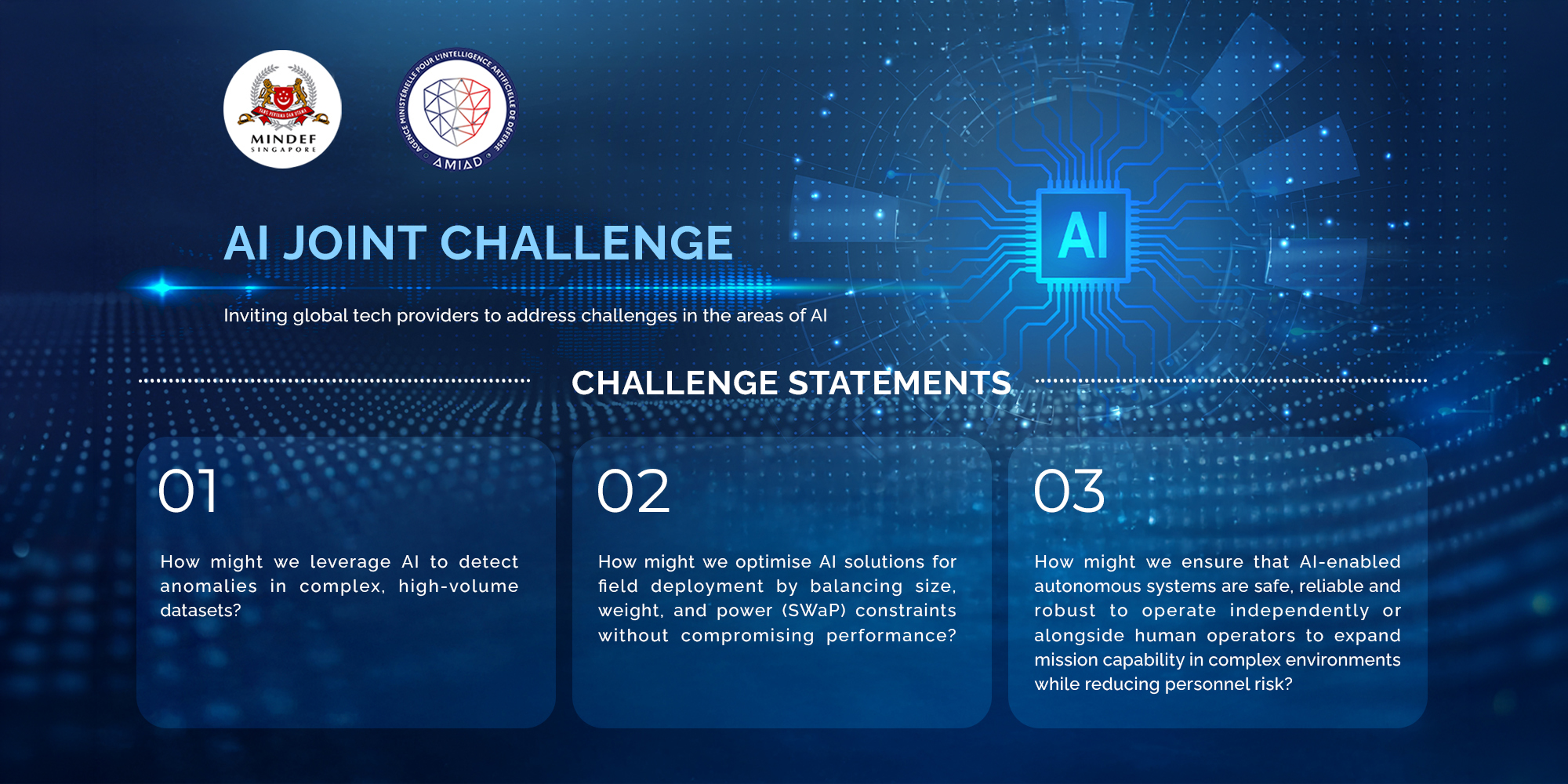
| Inviting startups, companies and academia to address the following challenges. 1. How might we leverage AI to detect anomalies in complex, high-volume datasets? 2. How might we optimize AI solutions for field deployment by balancing size, weight, and power (SWaP) constraints without compromising performance? 3. How might we ensure that AI-enabled autonomous systems are safe, reliable and robust to operate independently or alongside human operators to expand mission capability in complex environments while reducing personnel risk? |
| Challenge Owner(s) | Cap Vista |
|---|
Context
Operators today are often overwhelmed with information across multiple sources, which increases the likelihood of missing out on subtle warning signs. AI-enabled anomaly detection based on behavior analysis and intent inference for preemptive alerts could minimize the cognitive load of operators and increase their operational efficiency.
What We Are Looking For
We are looking for platform-agnostic capabilities capable of achieving the following within 12 months:
- AI-enabled anomaly detection based on behavior analysis and intent inference on multiple (video & text) streams to generate pre-emptive alerts.
- AI solutions capable of ingesting and analyzing multi-modal, large-scale datasets (text, images, video). Tools that highlight anomalies indicative of coordinated campaigns, or irregular activity.
- Approaches that balance detection accuracy with explainability, enabling human analysts to trust and act on outputs.
Key Metrics
- Detection Accuracy: Precision/recall in identifying anomalies or irregular activity.
- Scalability: Ability to handle millions of data points across diverse sources in near real-time.
- Explainability: Clear reasoning or traceability of flagged anomalies.
- Adaptability: Performance across different domains (e.g., defence OSINT, commercial data streams).
- Latency: Speed of detection and alerting for operational relevance.
Your Technology Solution Should Demonstrate
- Integration of AI/ML models with anomaly detection tailored for unstructured and semi-structured data.
- Visualization or dashboarding that enables analysts to interpret anomalies quickly.
- Modular architecture for integration with existing intelligence or monitoring platforms.
What A Trial Looks Like
- Pilot deployment on synthetic and real-world OSINT datasets (e.g., social media feeds, news archives, metadata). Evaluation against known mis/disinformation case studies and adversarial scenarios.
- Testing scalability across datasets of varying size and complexity.
- Up to 6 months trial with iterative feedback loops from analysts and stakeholders.
What We Are Not Looking For
- Purely academic prototypes without operational scalability. Black-box models with no explainability or analyst interpretability.
- Solutions limited to single-source datasets (e.g., only Twitter or only text).
- Tools focused solely on content moderation rather than anomaly detection and intelligence support.
Follow-On Implementation Cost
- Leasing or licensing option over a longer period.
| Challenge Owner(s) | Cap Vista |
|---|
Context
Operational environments, whether defence, humanitarian, or expeditionary, demand AI systems that are portable, rugged, and energy-efficient. Traditional AI deployments often rely on large compute clusters or cloud connectivity, which are impractical in austere or contested settings. Balancing SWaP is critical to ensure AI can be embedded into edge devices, unmanned platforms, and portable systems, enabling real-time decision-making under resource constraints.
What We Are Looking For
We are looking for platform-agnostic capabilities capable of achieving the following within 12 months:
- AI architectures and hardware solutions designed for low-SWaP environments. Techniques for model compression, pruning, quantization, or edge optimization.
- Hardware/software co-design approaches that maximize efficiency while maintaining mission-critical accuracy.
- Solutions deployable on portable, ruggedized platforms (e.g., drones, vehicles, handheld devices).
Key Metrics
- Energy Efficiency: Power consumption per inference or per mission cycle.
- Performance Retention: Accuracy and latency compared to baseline models.
- Form Factor: Reduction in physical size and weight for portability.
- Resilience: Ability to operate in contested, disconnected, or harsh environments.
- Integration: Compatibility with existing field systems and sensors.
Your Technology Solution Should Demonstrate
- Deployment-ready AI models that run on constrained hardware (e.g., edge processors, GPUs, FPGAs). Clear trade-off analysis between performance and SWaP optimization.
- Modular design enabling scaling from handheld devices to vehicle-mounted systems.
- Robustness against environmental stressors (temperature, vibration, dust, electromagnetic interference).
What A Trial Looks Like
- Physical testing of solution on mutually-agreed edge device of suitable SWaP.
- Up to 6 months trial with iterative feedback loops from analysts and stakeholders.
What We Are Not Looking For
- Conceptual demonstrations without validation on constrained hardware.
- Solutions limited to overly specific algorithms/models.
Follow-on Implementation Costs
- Cost for scaled up field deployment beyond trial.
How might we ensure that AI-enabled autonomous systems are safe, reliable and robust to operate independently or alongside human operators to expand mission capability in complex environments while reducing personnel risk?
Context
AI-enabled autonomous systems such as UxVs are increasingly expected to perform complex tasks. These systems must remain safe, reliable and robust under uncertainties, including in unpredictable and dynamic changes in its surroundings.
What We Are Looking For
We are looking for platform-agnostic capabilities capable of achieving the following within 12 months:
- Solutions for software and/or hardware-in-the-loop testing of AI-enabled UxVs to simulate and inject a comprehensive range of unexpected behaviors from the environment to test and strengthen the safety, reliability and robustness of AI-enabled UxVs.
Key Metrics
- Interoperability: Ability to integrate with existing command‑and‑control systems and diverse platforms.
- Realism: Applicability of results in a real-world setting.
- Trust and Transparency: Human operators’ confidence in AI decisions and autonomy levels.
Your Technology Solution Should Demonstrate
- Explainable AI outputs that allow operators to understand and validate AI safety, reliability and robustness.
- Modular deployment options for integration into existing robotic and unmanned systems.
What A Trial Looks Like
- Iterative hardware-in-the-loop testing of UxVs under simulation environments.
- Up to 6 months trial with iterative feedback loops from operators and mission planners.
What We Are Not Looking For
- Standalone robotic systems with no integration into collaborative combat frameworks.
- Black‑box solutions that lack transparency or operator trust.
- Solutions requiring persistent high‑bandwidth connectivity without fallback modes.
- Concepts limited to laboratory demonstrations without operational pathways.
Follow-on Implementation Costs
- Physical testing of UxVs under operational stress.
- Cost for deployment beyond trial.
Sign up for the latest innovation updates
Customise your preferences to receive updates in industries you're interested in.